Article
The Art and Science of Coffee Roasting
Coffee roasting is the moment green beans transform into the aromatic, flavorful coffee we love. By carefully controlling heat, airflow, and time, roasters shape everything from bright fruity notes to deep chocolate richness. In this guide, you’ll learn the key roast phases, roast levels, and techniques that turn raw potential into a perfect cup.
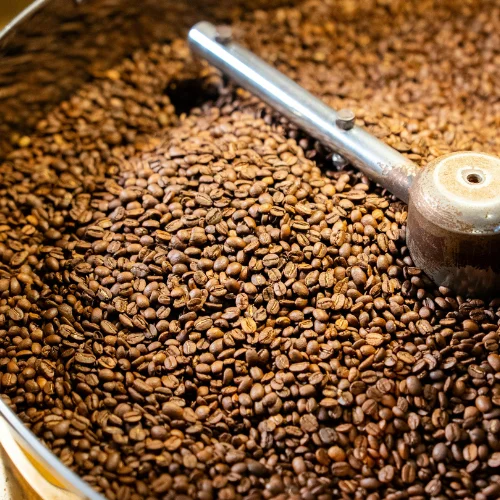
Roasting is where coffee is born — not on the farm, but in the fire. It is the transformative process that takes a raw, green seed and turns it into a fragrant, flavorful bean. Without roasting, coffee is grassy, acidic, and nearly undrinkable. But with it, we unlock a universe of aroma, texture, and taste.
At its heart, roasting is both chemistry and craftsmanship. It is about time, temperature, and transformation — but also intuition, memory, and care. To roast well is to speak the language of heat and bean.
From Seed to Flame: What Is Coffee Roasting?
Green coffee beans are dense, pale, and odorless. Their potential is latent — bound in cellulose, chlorogenic acids, and bound sugars. Roasting breaks down those structures, initiating Maillard reactions, caramelization, and the release of hundreds of volatile aromatic compounds.
The goal of roasting is to balance:
- Development of flavor (nutty, chocolatey, fruity, floral)
- Body and mouthfeel
- Acidity and sweetness
- Solubility for brewing
Roasters work to emphasize or soften certain qualities depending on the origin, processing method, and intended brew method. A washed Ethiopian coffee, for instance, might be roasted lightly to preserve jasmine-like florals, while a natural Brazil might be pushed slightly darker to deepen chocolate and walnut notes.
Phases of the Roast
The roasting process unfolds in distinct but interconnected stages. Understanding these phases is essential for both production roasters and curious home enthusiasts.
- Drying Phase (0–4 min, ~150°C)
- Green beans begin to lose moisture (~10–12% by weight).
- The beans smell grassy or hay-like.
- Internally, water turns to steam, setting the stage for pressure buildup.
- Maillard Reaction Phase (4–8 min, ~150–180°C)
- The turning point where sugars and amino acids react.
- Color changes from green to yellow to light brown.
- Aromas begin to resemble bread, toast, nuts.
- This phase builds the core flavor complexity.
- First Crack (180–200°C)
- An audible popping sound occurs as cell walls rupture.
- The bean expands in size, becoming more porous and brittle.
- This is a critical milestone: a light roast can be dropped here.
- Development Phase (post–First Crack, 200–220°C)
- Roasters determine the final flavor profile here.
- Stretching this phase enhances sweetness and balance.
- Too short, and the roast tastes underdeveloped (grassy, sour).
- Too long, and it can turn smoky, ashy, or bitter.
- Second Crack (220–230°C)
- A quieter, more rapid crackling sound.
- Sugars begin to carbonize.
- The oils migrate to the surface.
- Entering second crack signals the dark roast range.
- Beyond Second Crack (230°C+)
- Risk of scorching, tipping, or fire.
- Structural integrity breaks down.
- Beans take on oily sheen and lose origin character.
Roast Levels: Light, Medium, Dark
There is no universal standard, but roast levels are generally described as:
- Light Roast
Bright acidity, complex aromatics, high origin clarity.
Roasted to just after first crack.
Common for Nordic and third-wave styles. - Medium Roast
Balanced sweetness, moderate acidity, more developed body.
Often roasted just short of second crack.
Popular in American specialty cafés. - Dark Roast
Lower acidity, heavier body, roasty or smoky notes.
Roasted well into second crack.
Common in traditional French or Italian-style espresso.
Each level has its audience. There is no "best" roast — only what is best for the bean, the brew, and the drinker.
Roasting Equipment and Techniques
Roasting can be done with:
- Drum roasters (e.g. Probat, Diedrich): large rotating drums heated by gas or electric elements.
- Fluid-bed roasters (e.g. Sivetz): use hot air to suspend and roast beans quickly.
- Hybrid roasters (e.g. Loring): energy-efficient systems with high control.
- Home roasters: from popcorn poppers to dedicated machines like the Behmor or Aillio Bullet.
Regardless of scale, the principles remain: control of charge temperature, airflow, rate of rise (RoR), and development time ratio (DTR).
In modern roasting, tools like Cropster or Artisan software help log and analyze roast curves — temperature over time — offering precision and repeatability.
Roasting as Craft
But numbers alone aren’t enough. Great roasters listen: to the sound of cracks, the smell of caramelizing sugars, the color of the bean. As Scott Rao writes in The Coffee Roaster’s Companion (2014, p. 23):
“Roasting is both an art and a science. Good data is essential, but good instincts make the difference.”
Cupping — the professional tasting of roast results — closes the loop. A skilled roaster tastes not just for defects, but for balance, sweetness, texture, and the story the coffee wants to tell.
A Roast Is Never Just a Roast
To roast coffee is to translate potential into experience. It is an act of respect — for the farmer’s work, for the terroir of the land, and for the drinker who may never see either.
Each roast is a decision: what to highlight, what to soften, when to stop. And each roast invites a question: What might this coffee become?
In a world of speed and automation, roasting reminds us that some things are still made with care, by hand, with attention. From the first scent of hay to the final turn of the trier, it remains one of the most vital and soulful acts in all of coffee.